

Resurrection - Tolstoy's forgotten gem
In the shadow of his monumental novels, Tolstoy's "Resurrection" offers a very direct discourse on personal redemption and societal ills. It is very much worth reading.

When approaching Leo Tolstoy’s Resurrection, I think it is useful to abandon comparisons with his two widely acclaimed works, War and Peace and Anna Karenina, both of which are considered among the best novels of all time. Of those two, I have only read Anna Karenina, and its plot, its characters, the relationships, and the psychological intricacies that Tolstoy brings out in masterful prose are of a different, higher quality than what readers will find in Resurrection, his much later work.
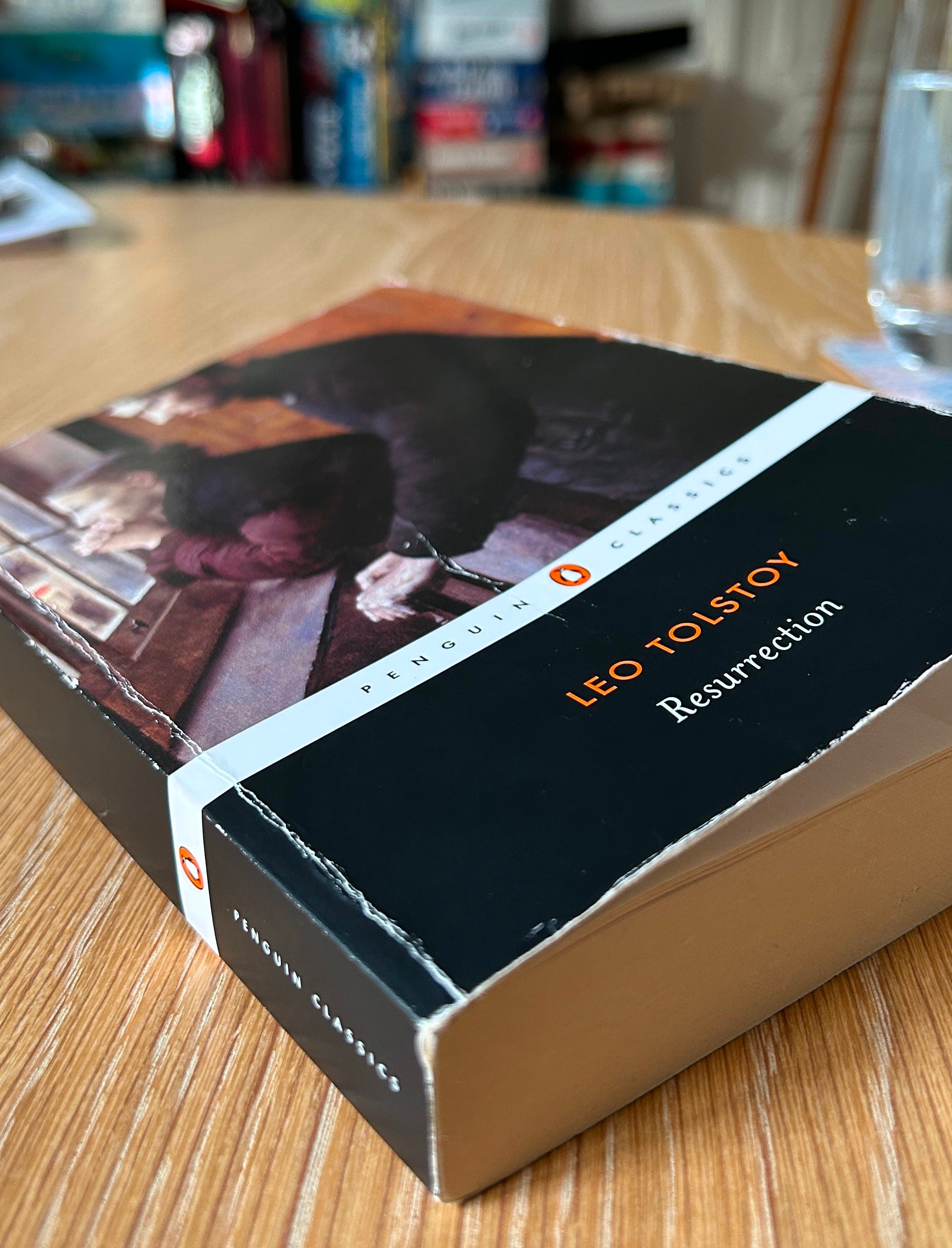
However, such comparisons are almost pointless because Tolstoy’s approach and direction are so different in Resurrection that it almost feels like a different subgenre altogether. Indeed, it reads as part novel and part essay. And the essay bits are every bit as interesting and thought-provoking as anything found in his earlier works, I think. The style is much more straightforward. There is less to unpack in a literary sense but far more to learn and discuss in a political, sociological, and religious/moral one. The main character, Nekhlyudov, expresses his growing sense of despair as he uncovers the perils of Russia’s poor and unfortunate. He does not hide his disdain for a broken bureaucratic system that is less attuned to dispensing justice and more focused on the advancement of petty bourgeois citizens with their petty concerns and petty intrigues. The inner turmoil within the main character, as well as his conflicting thoughts, is likewise laid bare for the reader to enjoy and ponder.
Does this more direct approach diminish Resurrection as a literary work? Perhaps. Was I left with a series of questions on how personal redemption can be brought about and at what cost? With a deeper understanding of why Russian society in 1899 was ripe for social and political revolution? With a smile on my face at the numerous humorous and almost satirical portrayals of bureaucratic nightmares and petty officials that still resonate to this day? Da. Da. Da. If you, dear lost reader of the Scriptorium, are interested in any of the themes above, then disregard the questionable reputation of Resurrection and give it a go.
From personal to procedural injustice — one of the best courtroom scenes in novel form
The first third of Resurrection sets out the central plot point, and it is also my favourite part of the book. It is immediately gripping; the instant presence of humour was a pleasant surprise, and the moral qualms are laid bare in brutal fashion.
The young, affluent, and self-confident aristocrat Dmitri Nekhlyudov has been called up for jury duty. The trial is full of satirical overtones, yet at its core lies a true personal tragedy. A young woman from a brothel, Katerina Maslova, is tried for murder by poison. But this is not just any young woman who has been forced by circumstance to sell her body to eke out a living. It is a young woman seduced, impregnated, and instantly abandoned by a young, affluent, self-confident man named Dmitri Nekhlyudov. Tolstoy masterfully interlaces two timeframes: the trial itself and the flashback story of Nekhlyudov’s and Maslova’s brief but intense and passionate encounter. We learn of the tragic sequence of events that slowly but surely destroyed Maslova’s life until the very moment when she stands to be tried for murder and quite possibly sentenced to hard labour in Siberia — for a crime she did not commit. Due to the circumstances of her life, very much caused by the brief, throwaway passion of a young Russian aristocrat, she, the innocent, would suffer; he, the guilty, would walk free and continue a good, carefree life.
Maslova’s tragedy. Nekhlyudov’s past (and current) conduct. The unfolding forensic and procedural details of the trial. Nekhlyudov’s growing despair and inner turmoil: What have I done? This part of Resurrection is as gripping and touching as anything else I have read by Tolstoy or Dostoevsky. The blending of tragedy, comedy, and moral dilemma is first-class.
Nekhlyudov realizes there is more at stake here than the mere possibility of a woman being wrongly convicted of murder. He has personal stakes in this trial now (not exactly fitting for a juror, of course). His very conduct is the root cause of the defendant’s predicament. He has to do something — and he does. The deliberation of the jury is another piece of first-class storytelling. The reader exhales with genuine relief when it looks like justice will indeed prevail and the poor woman be acquitted. Surely, the story of redemption on behalf of Nekhlyudov will continue from that point?
Alas. Just as it seems that the Russian justice system will prove its quality, a clerical error, a bureaucratic misstep, or an honest mistake of procedure leads to the wrong sentence being dealt out. The judge cannot quite believe it, but he feels he cannot do anything about it. Maslova is sentenced to prison and hard labour in Siberia – in spite of the jury’s de facto conclusion of her innocence. No malice here, just a glitch in the system.
This sets off Nekhlyudov’s earnest attempts to right this wrong. He has the time, the means, and the contacts to do his best. Yet a growing sense of guilt stirs something deeper within him. While pursuing the procedural paths to true justice, he realises that not just Maslova’s fate but the entire system – the core of society – is more rotten than he had realised. And he has been a part of it. Convinced that something radical needs to change, he vows to do anything he can to save Maslova – even if it means throwing away his good standing in society and marrying a common woman – and a convicted criminal at that – if she would want him to do so. Will she?
The central theme: true penance or pursuit of selfish feel-good?
The second part of the novel focuses on the renewed relationship between Nekhlyudov and Maslova, as well as Nekhlyudov’s pursuit of justice for Maslova – and redemption for himself. Three dynamics stand out in this middle act: Maslova’s questioning of Nekhlyudov’s motive, the Russian prison system, and Nekhlyudov’s earnest attempt at broader redemption through a personal disavowal of property for the benefit of the peasants working his land.
Maslova is scathing and resentful of Nekhlyudov, easily realising and vocalising that his new conduct revolves less around Maslova and more around Nekhlyudov himself. She refuses to be the vessel with which he seeks to redeem himself and rid himself of his guilt. Nekhlyudov acknowledges this, but he nevertheless continues his pursuit of justice and the alleviation of Maslova’s suffering. And this is indeed the central moral theme of the book: Is altruistic behaviour to be condoned, applauded, and emulated if the roots of such behaviour are in fact selfish? Is it a kind of utilitarian hypocrisy where your charity and sacrifice might lead to objectively better outcomes for others but where the true goal is to feel better about yourself?
Tolstoy does not give us his true answer until the end of the book, but my interpretation is that he does believe that such a course can be just. However, it has to be backed by more than just a token gesture of compassion or altruism. To atone for past sins of true selfishness, it is necessary not only to donate a kopek every month but to truly, personally, and actively embrace a life of doing something for other people. That is the path to true redemption and resurrection. And it lies at the heart of Tolstoy’s understanding of true Christianity – as compared to his scathing portrayal of the empty rituals and mysticism of the Orthodox Church of his time, also showcased in a brilliant and memorable set piece in Act 2.
This struggle with guilt and redemption is the core of the entire novel, and it provided me with plenty to reflect upon. Indeed, I seek to soothe my soul with monthly donations to a couple of charities, but it feels like such a throwaway gesture. What do I otherwise do in my existence to make life better for other fellow humans? Not much. And definitely not much compared to the many things I do to make my own life better. So, what should the conclusion be? That I halt my token donations since they are done for my sake as well – and that they are insufficient in and of themselves? Even as I find Tolstoy’s message of active compassion and helping others persuasive, I still conclude that even my hypocritical and surface-level contributions are better left in place lest I pull the plug simply to feel an odd sense of intellectual superiority: “There, I no longer do false altruism based on selfishness.” It does not seem right either. Yet, the message of Resurrection still resonates: one can and should always do more. So the goal is not intellectual superiority but practical action. And thus, I refuse to end my token monthly donations; instead, I will seek to do more for others in my daily life. Such is the power of this novel that I reflected upon these themes many times in the weeks of reading it – and afterwards too.
Resurrection through revolution – the political discourse of saving Russia and its people
This theme of intellectual versus practical betterment is not only explored at the personal level through Nekhlyudov but also through Tolstoy’s truly revolutionary characters. The main character meets a number of political prisoners who debate the different paths of revolution that could improve Russian society, do away with the injustices that have been laid bare in the first two-thirds of the book, and finally lead to a better life for the vast majority of the country’s people. Here too, Tolstoy quietly passes judgment on the different types of revolutionaries: the ones who seek to educate the people and to bring about change from the bottom up, and the ones who speak in favour of toppling the current corrupt system in order to take control themselves and wield power on behalf of the people – but without waiting or seeking to involve the people themselves.
There are numerous quotable passages in these exchanges that truly enhanced my understanding of pre-revolutionary Russia at the turn of the previous century. I think I want to quote this one in full (Part 3, Chapter 14):
‘I’ll tell you what I think,’ said Novodvorov. ‘If we want to do anything, there is one condition that needs to be fulfilled. Fantasy will not do. We have to see things as they are – which means doing everything we can for the masses without expecting anything in return. Everything we do is directed at the masses, but they can’t collaborate with us while they’re in their present state of inertia,’ he began, as if he was launching forth into a public lecture. ‘So, we’re totally deluding ourselves if we expect help from them before the process of development has taken place – and that’s what we are preparing them for.’
‘What process of development?’ put in Kryltsov, colouring up as he spoke. ‘We’re taking a stand against arbitrary rule and despotism, but isn’t this despotism of the most appalling kind?’
‘No, it isn’t,’ Novodvorov replied, keeping calm. ‘All I’m saying is this. I know what path the people have to go down, and I can show them where it is.’
‘But how do you know for certain the path you’re showing them is the right one? Isn’t this the same kind of despotism that led to inquisitions and executions during the French Revolution? They knew the one true path – scientifically.’
‘They may have got things wrong, but that doesn’t prove that I have. Anyway, there’s a big difference between the ravings of ideologists and facts produced by positive thinking and modern economics.’
Tolstoy wrote this in 1899, and this little passage resonates so strikingly against the actual events of 1917, against the USSR’s forced collectivisation, against Stalin’s purges.
Resurrection has many other memorable moments. When Nekhlyudov – in his altruistic and almost anarchist convictions – tries to give away his land to the peasants who work it, they are sceptical – indeed, outright hostile. “Why would this rich man give away his land? Surely it is simply a new, even more clever and more cruel, way of exploitation? Something stinks. We will not accept it.”
Tolstoy also shows that the path to redemption is not an easy one. More than once is Nekhlyudov tempted or sorry to continue his journey away from affluence, pleasure, and importance. Yet the fire is ever rekindled within him at the next instance of injustice that he is faced with. And throughout all these episodes, tragic as they are, Tolstoy sprinkles humour and humanity in equal doses, rendering Resurrection a less heavy read than one might think.
If I have but one major criticism of the novel, it is that the supposedly central relationship between Nekhlyudov and Maslova remains somewhat underdeveloped. Especially in the final third, I feel there is scope for more dialogue – more interaction. I would not go as far as to say that Maslova completely fades as an independent character, but given her importance in the first half of the book, the sense of development and drama is somewhat lacklustre.
Yet perhaps that is just another layer of Tolstoy’s message. Just as Nekhlyudov is the spark that causes Maslova’s life to go wrong in her youth, so now Maslova is the spark that causes Nekhlyudov to take off his blindfold and see the corrupt system, the hypocrisy all around him, and to befriend the many people oppressed by it. And that is why Resurrection shines in its own particular fashion: part novel, part essay, scathing social commentary – yet not only through tears and anger but also comedy and satire. And at its core, a clear message: redemption – and resurrection – is possible. For the individual and for society. But it is not enough to muse about it intellectually; it has to be achieved through practical action.